How to Find the North Star (and Use It to Find North)
Compiled and fact-checked from cited sources, reviewed by our editorial team. · Last updated:
Most people looking for the North Star start with the same two mistakes: they hunt for the brightest star, and they look straight up. Both are wrong.
Polaris is not the brightest star in the sky — it is roughly the 48th brightest. And it is never overhead unless you are standing at the North Pole. Its height above the horizon equals your latitude, exactly. From New York that is 41°; from London 51°; from Los Angeles 34°.
That single fact is both the key to finding Polaris and the way to confirm you have found it: if you are in the continental United States and you’re looking at a bright star 70° up, that is not the North Star.
Below: two reliable ways to find it, how to verify it, and how to turn it into a direction.
Method 1: using the Big Dipper
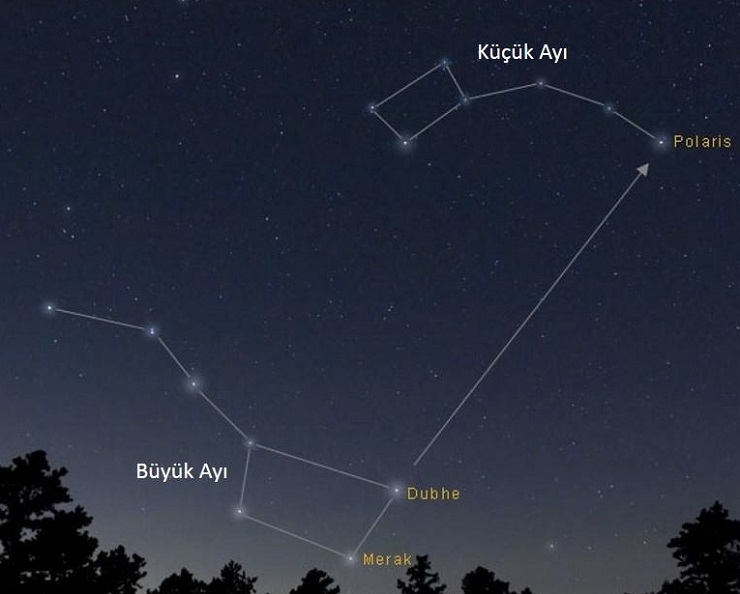
The best-known and most reliable route. The seven bright stars of Ursa Major form a Dipper (in Britain, the Plough), visible year-round from most of North America and Europe.
- Find the Dipper. Four stars make the bowl, three the handle. Depending on season and hour it may sit upright, upside down or on its side — the shape never changes, only its orientation.
- Pick the two stars at the outer edge of the bowl. These are Dubhe (the upper, brighter one) and Merak. They are called the Pointers.
- Draw a line from Merak through Dubhe and keep going in the same direction.
- Travel about five times the gap between them. The moderately bright star you land on is Polaris.
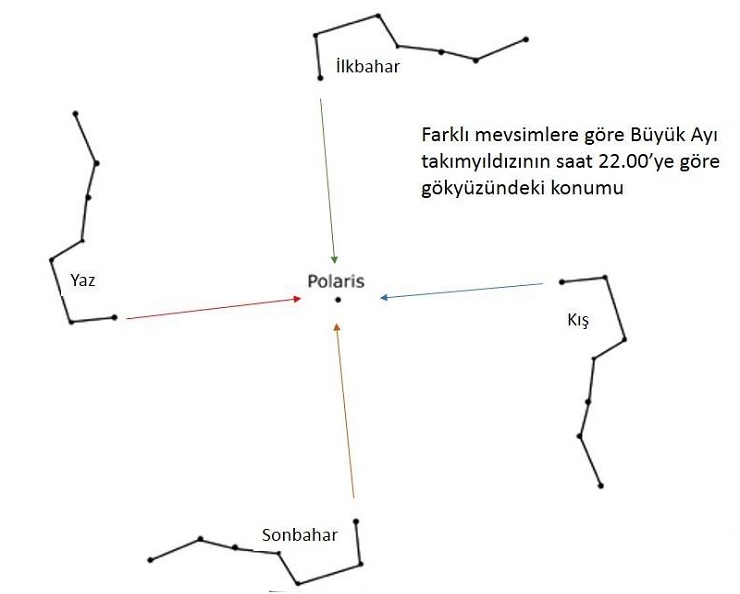
Why this works. Unlike the Dipper's other stars, Dubhe and Merak lie almost exactly on a straight line with Polaris. As the sky wheels counter-clockwise around the pole through the night, that alignment never breaks — the Dipper can be completely upside down and the pointer line still lands on the same star.
Method 2: using Cassiopeia
On autumn evenings the Big Dipper drops close to the horizon and can end up behind a hill, a building or trees. That is when Cassiopeia takes over.
Cassiopeia looks like a large W (or M when inverted) and sits on the opposite side of Polaris from the Big Dipper. When one is low, the other is high — you always have one of them.
- Find the W. It has five stars and stands out clearly.
- Pick the deeper of the two V-shaped notches.
- Follow the direction that notch opens toward, roughly twice the total width of the W.
- Polaris sits there, about halfway between Cassiopeia and the Big Dipper.
Practical tip: if you can see both at once, the job is easy — Polaris is near the midpoint of the line joining them.
Method 3: verify it with your fist
You can measure whether the star you found really is Polaris. A closed fist at the end of an outstretched arm covers roughly 10 degrees of sky.
- Stretch your arm out fully and rest your fist on the horizon.
- Stack fist over fist up to the star.
- Each fist ≈ 10°.
| City | Latitude | Polaris altitude | Fists |
|---|---|---|---|
| Miami | ~26° | 26° | ~2.6 |
| Los Angeles | ~34° | 34° | ~3.4 |
| New York | ~41° | 41° | ~4 |
| Chicago | ~42° | 42° | ~4.2 |
| Seattle | ~47° | 47° | ~4.7 |
| London | ~51° | 51° | ~5 |
| Edinburgh | ~56° | 56° | ~5.6 |
If your measurement falls far outside that, you are looking at the wrong star. The reason is simple: Polaris sits almost exactly where Earth’s rotation axis punches through the sky, so its height above the horizon is your latitude. At the North Pole (90°) it is overhead; at the equator (0°) it sits on the horizon.
Using Polaris to find north
Once you have it, the rest is trivial — and more accurate than a compass.
Face the star. You are facing NORTH.
- Behind you: south
- Right arm: east
- Left arm: west
Why it beats a compass. A compass points to magnetic north; Polaris points to true north. The difference is magnetic declination, and it varies with where you stand — in the continental US it ranges from roughly 20° west in Maine to 15° east in Washington state. Iron, power lines and your phone deflect a compass too. Nothing deflects a star.
How to actually walk with it: you cannot walk while staring upward. Instead, find Polaris, pick a landmark in that direction — a hilltop, a distinctive tree, a rock — then walk to the landmark. When you reach it, look up again and choose the next one.
Is the North Star really fixed?
Almost. Polaris is not exactly at the north celestial pole; it sits about 0.65 degrees away. That means it does trace a very small circle — roughly 1.3° across, about two and a half times the width of a full moon.
For hiking and orientation the offset is irrelevant. For precise work — polar alignment in astrophotography, celestial navigation — it matters and is corrected for.
More than that, Polaris has not always been the pole star. Earth’s axis wobbles like a spinning top on a 26,000-year cycle (precession):
- Around 2700 BC: the pole star was Thuban, in Draco. The Egyptian pyramids were aligned to it.
- Today: Polaris.
- March 2100: Polaris reaches its closest approach, about 0.5° from the pole.
- Around AD 13,700: Vega becomes the pole star.
Five common mistakes
- Looking for the brightest star. Polaris is magnitude 2, roughly 48th in the sky. Sirius, Vega, Arcturus and Capella are all far brighter. You find it by position, not brilliance.
- Looking straight up. Polaris is overhead only at the North Pole. From mid-latitudes it sits somewhere between a third and two-thirds of the way up.
- Trying it in the southern hemisphere. Below the equator Polaris is under the horizon. There, the Southern Cross does the job instead.
- Confusing it with a compass bearing. A compass gives magnetic north. If you are working with a map and need accuracy, you have to know your local declination.
- Trying it under city lights. Polaris is only moderately bright, and light pollution or a full moon can wash it out. Get away from lights and give your eyes 15-20 minutes to dark-adapt — no phone screen during that time.
Worth knowing about Polaris
It is three stars, not one. Polaris is a triple system: the supergiant Polaris Aa plus two companions, Polaris Ab and Polaris B.
It is a Cepheid variable. Its brightness changes slightly on a cycle of about four days. You cannot see it by eye, but that property makes it important for measuring cosmic distances.
Its distance is still debated. Hipparcos data gave about 433 light-years; Gaia data gives about 446-448 light-years. Either way, the light hitting your eye tonight left Polaris more than four centuries ago.
It is Alpha Ursae Minoris. The brightest star of the Little Dipper, at the tip of its handle.
If you want the daytime and no-star techniques as well — sun, shadow stick, watch method — those are collected separately.
Frequently Asked Questions
How do I find the North Star? Find the Big Dipper, take the two stars at the outer edge of the bowl (Dubhe and Merak), and extend the line between them about five times in Dubhe’s direction. The moderately bright star you reach is Polaris.
How do I use the North Star to find north? Turn to face Polaris and you are facing true north. South is behind you, east on your right, west on your left. To walk at night, pick a landmark in that direction rather than staring at the sky.
Where is the North Star in the sky? At the tip of the Little Dipper’s handle, about 0.65 degrees from the north celestial pole. Its height above the horizon equals your latitude.
Is the North Star the brightest star? No. At magnitude 2 it is roughly the 48th brightest star in the sky. Sirius, Vega and Capella are all noticeably brighter.
Can I see Polaris all year? Yes, from anywhere in the northern hemisphere above about 25° latitude it never sets. It stays in the same spot all night, every night, weather permitting.
How high above the horizon is Polaris? Exactly your latitude. About 41° in New York, 51° in London, 34° in Los Angeles. Since a fist at arm’s length spans about 10°, that is roughly 3 to 5 fists.
What if I can’t see the Big Dipper? Use Cassiopeia. The W-shaped constellation sits on the opposite side of Polaris, so when the Dipper is low, Cassiopeia is high.
Does the North Star move? It traces a tiny circle about 1.3° across, because it sits 0.65° off the true pole. To the naked eye it looks fixed; astrophotographers and navigators correct for the offset.
Has Polaris always been the North Star? No. Because Earth’s axis precesses over 26,000 years, the pole star changes. Thuban held the role around 2700 BC, Polaris does now, and Vega will around AD 13,700.
Is there a South Star? Not really — no bright star sits at the south celestial pole. Instead the long axis of the Southern Cross is extended to locate south.
How far away is Polaris? Between roughly 433 and 448 light-years depending on the measurement method. The light you see tonight left it more than four hundred years ago.
What is the difference between Polaris and a compass? A compass shows magnetic north and drifts with your location and nearby metal. Polaris shows true geographic north and cannot be deflected.
Can a phone app find the North Star? Yes, sky apps work well. But phone compasses are affected by metal and magnetic fields, so use the app to learn the position and confirm with the Big Dipper and the latitude check.
When is the best time to see it? On a clear night with little moonlight, away from city lights, after letting your eyes adapt for 15-20 minutes.
Is the Plough the same as the Big Dipper? Yes. It is the same seven-star pattern in Ursa Major — “the Plough” in Britain and Ireland, “the Big Dipper” in North America.
Sources
- EarthSky — Polaris is the present-day North Star. https://earthsky.org/brightest-stars/polaris-the-present-day-north-star/
- EarthSky — Does the North Star ever move in the sky? https://earthsky.org/astronomy-essentials/north-star-movement/
- Toward Ending the Polaris Parallax Debate: A Precise Distance to Our Nearest Cepheid from Gaia DR2, Research Notes of the AAS. https://iopscience.iop.org/article/10.3847/2515-5172/aad2d0
- Sky & Telescope — What’s the distance to Polaris? https://skyandtelescope.org/astronomy-resources/astronomy-questions-answers/distance-for-polaris/
- NOAA NCEI — Magnetic declination calculator. https://www.ngdc.noaa.gov/geomag/calculators/magcalc.shtml